
Category Archives: My Opinion Only

Why Canada Might Benefit from Musk’s Way of Doing Things

Only On The Walters Post

These are my own thoughts from what I’ve seen and lived through. I’m sharing them to spark some thinking and honest conversation, not because I have all the answers.

You know—I’ve been around long enough to know that a lot of government spending doesn’t always go where it should. In fact, there’s a lot of waste, and when it’s pointed out, it’s hard to ignore. Down in the U.S., Elon Musk’s been given a bit of leeway to dig into the government’s spending, and what he’s finding isn’t pretty. From the looks of it, there are trillions of dollars spent on things that don’t make sense, and Musk’s not afraid to call it out.

Now, Musk is a guy who knows how to manage large organizations, and whether you like his style or not, you can’t argue with the fact that he gets things done. President Trump said that Musk’s job isn’t to make decisions on his own, but to help uncover wasteful practices and bring them to light. And it seems like Musk’s team is finding some pretty staggering numbers—bad spending, poor management, and all sorts of things that are hard to explain.

Here’s the thing: Canada’s not much different. We have our own share of inefficiencies and questionable spending, and maybe it’s time we looked at bringing in someone who doesn’t care about politics or bureaucracy. Maybe we need someone who’s willing to roll up their sleeves, take a hard look at where our money’s going, and say, “This can be done better.”

Sure, some folks may say Musk’s too much of a maverick, but when you’re dealing with waste like this, maybe it’s time for a bit of boldness. We’ve seen what Musk has accomplished with his companies, and it’s hard not to think that we could use a bit of that energy here to straighten things out.

So, here’s to finding the waste and cutting it down. Maybe if Musk can do it, I think we need someone like him here in Canada.

Until next time—keep your minds open and your stories alive! GW

All my books are available on my Amazon Author Page.

If you purchase a book, a brief Amazon review really helps new readers discover my work—it means a lot.

Support my writing: Support My Writing

In Closing, I Would Like to Wish You Well!

George Walters | [email protected]
The Reality of “Made in Canada/Product of Canada” – Until We Fix This, It’s Just Talk

As someone who’s spent a lifetime working the land, seeing the seasons come and go, and building up a life from the soil, I’ve come to realize something – all this talk about making and producing things here in Canada, it’s just that: talk. Sure, there’s plenty of hype about buying local, growing local, but the truth is, until we deal with the mess between provinces, things aren’t going to get any better.

For decades, we’ve had to work within a system that’s stuck between provincial borders. It’s a system that lets each province make their own rules, and more often than not, those rules stop goods from moving freely between us. We talk about supporting Canadian farmers, Canadian businesses – yet, when it comes down to it, our own laws get in the way of that.

Take a simple example: You can’t even send a shipment of produce or goods from one province to another without running into red tape. Each province has its own set of standards and regulations, and it doesn’t matter if you’re growing the same damn tomatoes in Ontario or B.C. – the government in each place will have its own idea of how things should be done. That’s the problem with the system we’ve built. You can’t have “Made in Canada” if we’re not able to trade freely across our own borders.

And let’s talk about what gets in the way of making things here. The infrastructure is there in some areas, but when you add in all the hoops to jump through, things get complicated fast. I’ve seen it myself – a farm product, perfectly good and ready to be shipped to another province, gets held up because of rules that don’t even make sense in the first place.

So, until we get this sorted out – until the provinces decide to stop playing their own games and start working together – we’ll keep seeing this disconnect between what we say we want and what we can actually do. It’s time we face the facts: supporting Canadian-made is going to be a lot harder if we can’t even figure out how to trade across our own damn country.

If we’re serious about strengthening our local economies and securing our future, it’s time to demand that our leaders fix this mess. Until then, it’ll be business as usual: more talk, less action.

Until next time—keep your minds open and your stories alive! GW

All my books are available on my Amazon Author Page.

If you purchase a book, a brief Amazon review really helps new readers discover my work—it means a lot.

Support my writing: Support My Writing

In Closing, I Would Like to Wish You Well!

George Walters | [email protected]

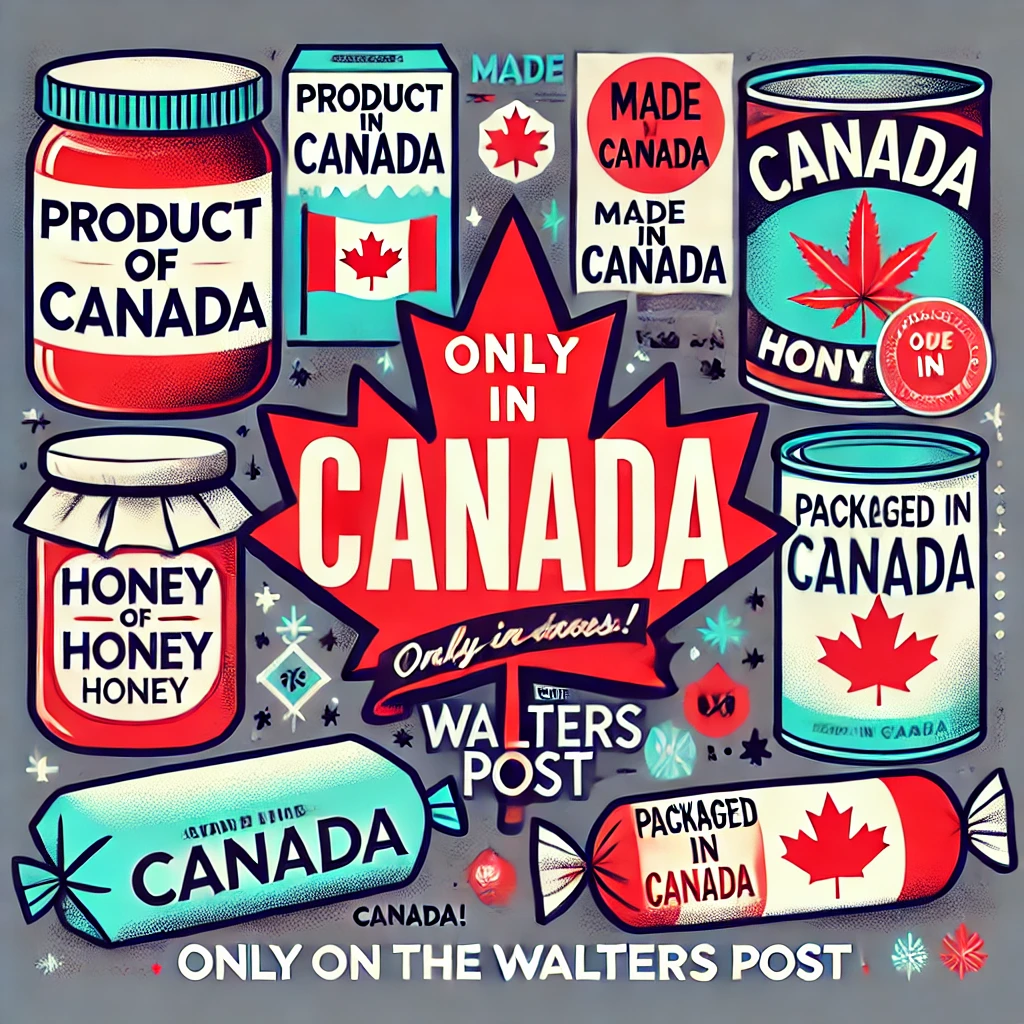
The Truth About “Made in Canada,” “Product of Canada,” and “Packaged in Canada” – Don’t Be Fooled

Click on Image to Enlarge!

Now, I’ve been around long enough to know that words can be tricky. Companies, politicians, and marketers like to play word games, and if you’re not paying attention, you might think you’re buying something Canadian when you’re really just getting a label with a maple leaf slapped on it. So, let’s clear up the nonsense and get to the truth about these so-called “Canadian” products.

“Product of Canada” – The Real Deal

If you see “Product of Canada” on a label, that means nearly everything in that product is from right here in Canada. According to the rules, at least 98% of the ingredients and materials must come from Canada, and the product must be processed here too. That’s as close as you can get to a truly Canadian product.

Example: If you buy a jar of honey labelled “Product of Canada,” that honey came from Canadian bees, tended by Canadian beekeepers, and put in a jar right here at home. That’s the good stuff.

“Made in Canada” – A Bit of a Mixed Bag

Now, “Made in Canada” sounds good, but there’s a catch. Only 51% of the total cost of making that product has to be from Canada. That means a lot of the ingredients or materials could come from other countries, but as long as the final product is put together or processed here, they can slap “Made in Canada” on it.

Example: Let’s say you buy a loaf of bread labelled “Made in Canada.” The wheat might be from the U.S., the yeast from Europe, and the packaging from China—but as long as it’s baked and assembled here, it qualifies. So, it’s not quite as Canadian as you might think.

“Packaged in Canada” – A Sneaky One

Now, here’s where things get real tricky. “Packaged in Canada” means just that—the product was put in a box, bag, or jar here. That’s it. It says nothing about where the ingredients came from. A company could import fruit from Mexico, put it in a plastic tub in Ontario, and call it “Packaged in Canada.” Not exactly what most people would expect when they see Canada on the label.

Example: Ever seen frozen vegetables with a big Canadian flag but no clear statement on where the veggies came from? If it says “Packaged in Canada,” those peas could be from China, India, or who knows where. They were just put in a bag here. And let’s be honest—personally, I don’t care much for anything grown in China or India. I’d rather know my food came from Canadian soil, where I trust the standards and the farming practices.

Why This Matters

A lot of folks not all now a days, want to support Canadian farmers and businesses, especially with all these trade wars and economic ups and downs. But if you’re not paying attention, you might think you’re buying Canadian when you’re really not.

Here’s my advice: always read the labels closely. Look for “Product of Canada” if you want the real deal. “Made in Canada” can be fine, but keep in mind that some of the ingredients could be imported. And if it only says “Packaged in Canada,” take a moment to flip the package over and check where the ingredients actually come from. More often than not, those ingredients are sourced from elsewhere—sometimes even far from Canada. It’s a bit of a loophole, letting companies slap a Canadian label on products that don’t actually meet the standards of what we might expect from homegrown goods. So, don’t just trust the front of the package; the truth is often hidden on the back.

So yea—I’ve seen a lot of tricks in my day, and this one is right up there with the best of them. Don’t let clever marketing fool you. If you want to support Canadian businesses, make sure you know what you’re buying. Keep your money where it matters—right here at home.

Until next time—keep your minds open and your stories alive! GW

All my books are available on my Amazon Author Page.

If you purchase a book, a brief Amazon review really helps new readers discover my work—it means a lot.

Support my writing: Support My Writing

In Closing, I Would Like to Wish You Well!

George Walters | [email protected]

Elon Musk and the Powers That Be: The Good, the Bad, and the Price We Pay

Elon Musk stirs up strong opinions. Some see him as a visionary pushing humanity forward, while others think he’s a billionaire with too much power. But one thing’s certain—he gets things done. And that’s where the tension lies between him and the powers that be.

Take Ontario’s now-canceled $100 million contract with Starlink. It was meant to bring high-speed internet to 15,000 rural homes and businesses—something that’s been needed for years. But was it a good deal? Not really. The cost was high, and long-term expenses could have made it even worse. The government could have found a cheaper way, but let’s be honest—governments aren’t exactly known for efficiency. Meanwhile, people in remote areas are left waiting, while politicians play their games.

Musk, for all his wealth, isn’t the enemy of the working man. If anything, he’s provided real solutions where governments have dragged their feet. Without Starlink, many folks in rural Canada including myself would still be stuck with slow, unreliable internet. That’s a fact. But at the same time, relying too much on one company for public infrastructure is risky. Eventually, prices go up, and regular people foot the bill.

Ford’s move to cancel the deal may have been political—his way of pushing back against U.S. tariffs—but in doing so, he’s made life harder for those who actually needed the service. Now, with the tariff threat on pause for just 30 days, this whole situation might change again. Will the contract be reconsidered? Will tariffs come back and make things worse? Nothing’s certain, and that’s the real problem—decisions that impact everyday folks keep getting tossed around like political bargaining chips.

The takeaway? Musk isn’t perfect, but he’s filling a gap governments have ignored for too long. Meanwhile, politicians are playing games with decisions that affect real people. One way or another, it’s the working class that ends up paying the price.

Until next time—keep your minds open and your stories alive! GW

All my books are available on my Amazon Author Page.

If you purchase a book, a brief Amazon review really helps new readers discover my work—it means a lot.

Support my writing: Support My Writing

In Closing, I Would Like to Wish You Well!

George Walters | [email protected]

Canada’s Tariff Wake-Up Call: A Working Man’s Take

I’ve been around long enough to see how the world moves in cycles. I’ve seen boom times, recessions, and trade fights that left regular folks scratching their heads and tightening their belts. Now, here we are again—caught in another economic storm, this time thanks to tariffs slapped on Canada by the U.S.

So what does this really mean for the working man? Simple. Prices are going up. Groceries, gas, electronics—you name it. If it’s coming from the U.S., it’s about to cost us more. And if our government fights back with counter-tariffs, expect even more pain at the checkout counter.

Jobs could take a hit, too. Canadian businesses that rely on selling to the U.S. are going to struggle. Some might shut down, some might lay people off. A weaker dollar won’t help either—importing anything is going to cost more, and that’s going to ripple through every industry.

Sounds bad, right? Well, yeah, in the short term, it is. But let’s step back and look at the bigger picture. Maybe—just maybe—this is the slap in the face Canada needs.

For far too long, we’ve depended on other countries for what we should be doing ourselves. We buy American produce instead of growing more of our own. We import steel and computer chips instead of making them here. We’ve allowed entire industries to fade away because it was easier to buy cheap from somewhere else. That’s got to change.

This tariff mess could be the wake-up call we need to get serious about self-reliance. If our government plays it smart, they’ll push for more Canadian manufacturing, farming, and innovation. That means better jobs, stronger industries, and a future where we’re not at the mercy of foreign policies and trade wars.

It won’t happen overnight, and it won’t be easy. But if we start putting our money into Canadian goods and supporting businesses that keep things local, we might come out of this stronger. It’s time to stop depending on everyone else and start making and growing what we need right here at home.

So, yeah, times are about to get tougher. But maybe this is the fire Canada needs to finally stand on its own two feet. Let’s hope we don’t waste the opportunity. GW

All my books are available on my Amazon Author Page.

If you purchase a book, a brief Amazon review really helps new readers discover my work—it means a lot.

Support my writing: Support My Writing

In Closing, I Would Like to Wish You Well!

George Walters | [email protected]